
Many brands treat retail execution as something that happens after the important work is finished.
The product has been developed.
The retailer has approved the program.
The display has been designed.
Production is complete.
Products are shipped.
Now execution becomes an operations issue.
But that view misses something important.
A retail strategy doesn’t create value simply because it was planned well.
It creates value when that strategy is translated successfully into the store.
The display needs to be assembled.
Products need to be stocked.
Merchandising needs to remain consistent.
Inventory needs to be replenished.
And shoppers need to encounter the product in the way the program was designed.
That’s why retail execution isn’t simply the final operational step.
It is the connection between retail strategy and retail reality.
And when brands become consistently better at making that connection, execution can become a competitive advantage.
1. Retail Execution Is Often Treated as an Operations Problem
Retail programs typically involve many teams.
Marketing develops the campaign.
Design creates the visual direction.
Engineering develops the physical display.
Manufacturing produces it.
Logistics moves it.
Retail operations executes it.
Because execution happens near the end of that chain, it is easy to treat it as a downstream responsibility.
But the store doesn’t experience those functions separately.
The store experiences the result of all of them.
A difficult assembly process may originate in engineering.
Damaged components may relate to packaging or transportation.
Slow replenishment may result from structural decisions.
Inconsistent product presentation may be influenced by how the display organizes merchandise.
As we explored in How Retail Displays Affect Store Operations, many decisions made during display development eventually become operational realities inside the store.
So retail execution isn’t isolated from design.
Execution is where design, engineering, manufacturing, logistics, and store operations finally meet.
2. Retail Execution Affects More Than Operations
When execution varies, the impact doesn’t stop with the store team.
It can extend into several parts of retail performance.
Four relationships are particularly important:
Retail Execution → Product Availability
Retail Execution → Shopper Experience
Retail Execution → Brand Consistency
Retail Execution → Retailer Confidence
Together, they help explain why execution should be treated as a strategic capability rather than simply an operational checklist.
Retail Execution Can Affect Sales Conditions
Retail execution does not guarantee sales.
Demand, price, promotion, competition, seasonality, and product-market fit all influence retail performance.
But execution affects the conditions under which a product is sold.
Consider a product that is technically available in the store but:
- The display is half empty
- The product is difficult to find
- The wrong SKU is placed in the primary position
- Promotional messaging is hidden
- Inventory has not been replenished
The product is present.
The selling conditions are not the same.
How does retail execution affect sales?
Retail execution can support sales by helping products remain available, visible, accessible, correctly merchandised, and aligned with the intended promotional strategy.
This distinction matters.
Execution doesn’t create demand by itself.
It helps ensure that existing demand has the opportunity to convert into a purchase.
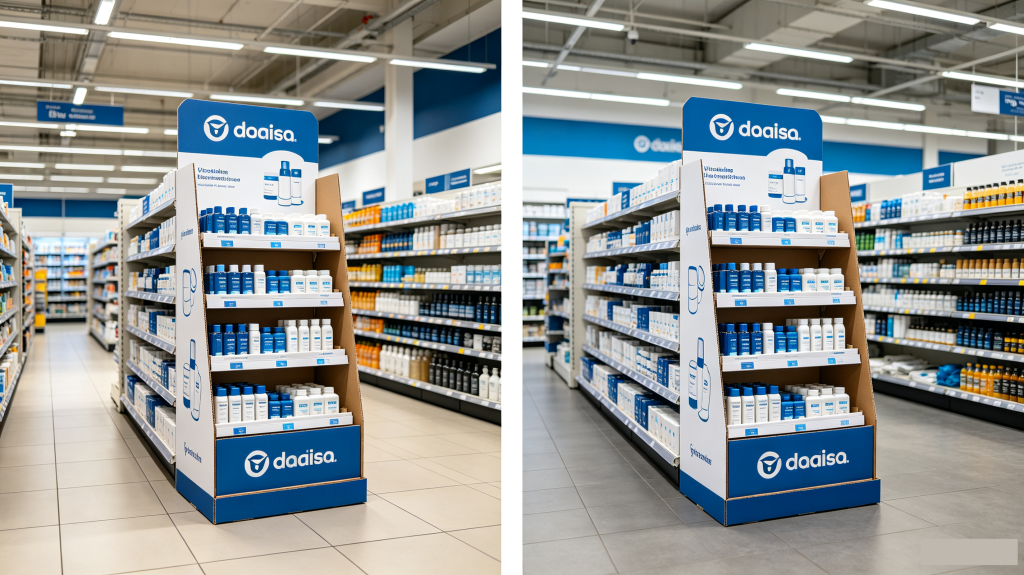
Retail Execution Shapes Shopper Experience
Shoppers don’t see the merchandising plan.
They see the store.
They don’t know what the approved rendering looked like.
They see the display in front of them.
They don’t know whether a product should have been replenished that morning.
They simply see an empty space.
This means many operational details eventually become shopper-facing details.
A correctly executed display can help shoppers:
- Find products
- Understand the assortment
- Compare options
- Access merchandise
- Recognize promotional messaging
- Navigate the display
An incorrectly executed one may make those same actions more difficult.
This is why shopper experience and store operations are more closely connected than they first appear.
Great retail displays should be designed for store teams, not just shoppers, because the store team’s ability to execute the display helps determine the experience shoppers eventually receive.
Retail Execution Protects Brand Consistency
Brands invest heavily in consistency.
Colors are controlled.
Graphics are approved.
Messaging is reviewed.
Product positioning is planned.
Displays are engineered around a specific merchandising concept.
But retail is where that controlled brand system enters an uncontrolled physical environment.
Different stores have different layouts.
Inventory levels change.
Products move.
Displays experience wear.
Promotional priorities shift.
Perfect consistency across every location may not be realistic.
But good retail execution helps reduce unnecessary variation.
The objective is to preserve the most important elements of the brand experience:
Correct Product
Correct Presentation
Correct Messaging
Correct Display Configuration
When those elements remain recognizable across locations, the physical retail environment reinforces the brand instead of gradually diluting it.
Retail Execution Can Build Retailer Confidence
Retailers are not only evaluating products.
They are also managing operational complexity.
Every new program interacts with:
- Store labor
- Floor space
- Inventory
- Distribution
- Replenishment
- Merchandising
- Promotional calendars
A program that repeatedly requires additional intervention creates friction.
A program that is easier to deploy and maintain creates less.
This is where execution can influence the brand-retailer relationship.
Brands that understand store realities can design programs that are easier to integrate into retail operations.
That does not mean retailers will automatically prefer one brand because its display is easier to assemble.
Retail relationships are far more complex than that.
But operational reliability can contribute to confidence in a brand’s ability to execute programs consistently.
And over time, consistency matters.
3. Execution Is Not Just Execution
The phrase “retail execution” can make the concept sound tactical.
Set up the display.
Stock the product.
Check the signage.
Move on.
But strong execution is really the result of many upstream decisions working together.
Consider the chain:
Display Design
↓
Display Engineering
↓
Manufacturing
↓
Packaging / Co-Packing
↓
Transportation
↓
Store Operations
↓
Retail Execution
If execution becomes difficult at the end of that chain, the cause may exist much earlier.
That’s why Why Retail Execution Breaks Down In Stores (And How Better Display Design Helps) focuses on reducing execution risk through better engineering rather than blaming stores when conditions vary.
The strategic question is not:
How do we force perfect execution?
It is:
How do we build a retail system that is easier to execute consistently?
That is a much more useful problem to solve.
Better Display Design Makes Execution Easier
Display design is one part of that system.
A well-engineered retail display can make certain store-level actions more intuitive.
Assembly
Can the display be set up correctly without unnecessary steps?
Replenishment
Can products be restocked without excessive handling?
Product Access
Can store teams load products easily while shoppers can remove them easily?
Durability
Can the display maintain its structure and presentation throughout the program?
Transportation
Can it reach the store in a condition that allows execution to begin as intended?
These are design questions.
But their consequences appear in operations.
Formats such as PDQ Displays can use product organization and retail-ready configurations to simplify merchandising.
Pallet Displays require engineering around inventory volume, transportation, footprint, stability, and shopper access.
Different formats create different execution challenges.
Good design anticipates them.
Co-Packing Can Move Complexity Upstream
Another way to improve execution is to ask a simple question:
Does this task really need to happen in the store?
Some programs require products, displays, labels, graphics, and other components to come together before merchandising.
Leaving every step to individual locations increases the number of variables at store level.
Where appropriate, Co-Packing Services can move tasks such as:
- Display assembly
- Product loading
- Labeling
- Pack-out
- Retail-ready preparation
upstream.
This changes the execution model.
Instead of:
Receive → Sort → Assemble → Load → Merchandise
a program may move closer to:
Receive → Place → Merchandise
The fewer unnecessary decisions required at store level, the easier consistent execution can become.
Manufacturing Is Part of the Execution System Too
Retail execution may happen in stores, but execution quality can be influenced much earlier.
A display engineered for simple assembly still needs to be manufactured accurately.
Dimensions need to work.
Connections need to fit.
Materials need to perform as intended.
Graphics need to align.
Packing needs to protect the structure.
That is why Retail Display Manufacturing should preserve the engineering intent rather than operate as an isolated production step.
The relationship is:
Engineering Intent → Manufacturing Accuracy → Store Usability → Retail Execution
When those stages stay connected, fewer problems need to be solved downstream.
4. Why Execution Can Become a Competitive Advantage
A competitive advantage doesn’t have to be something shoppers consciously recognize.
Sometimes it is a capability operating behind the scenes.
A brand may become better at:
Launching programs consistently.
Reducing store-level complexity.
Maintaining merchandising standards.
Keeping displays stocked and functional.
Adapting display systems to different retail environments.
None of these capabilities guarantees commercial success.
But together, they can make a retail program more repeatable.
And repeatability matters when a brand moves from:
10 stores → 100 stores → 1,000 stores.
At a small scale, execution problems can often be solved individually.
At a large scale, the system itself needs to work.
That’s where execution shifts from a task to a capability.
A brand that can repeatedly translate retail strategy into consistent store execution has an operational advantage that becomes increasingly important as retail programs scale.
The Competitive Advantage Is Consistency
The goal isn’t perfection.
Retail environments are too dynamic for that.
The goal is reducing the gap between:
What the brand intended
and
What the shopper actually experiences.
Better design helps.
Better engineering helps.
Better manufacturing helps.
Better co-packing helps.
Better store usability helps.
And together, those factors make consistent retail execution more achievable.
This creates the larger relationship:
Display Design
↓
Store Operations
↓
Retail Execution
↓
Shopper Experience + Brand Consistency
↓
Retail Performance
This is the loop brands should pay attention to.
Because a retail display isn’t valuable simply because it was successfully manufactured.
Its value is realized when the intended merchandising experience survives all the way to the shopper.
Display Design → Store Operations → Retail Performance
This is why SDPOP approaches Custom Retail Display Solutions [Internal Link → Homepage] as more than the production of a physical fixture.
A retail display sits inside a larger operating system.
Its structure affects assembly.
Its configuration affects replenishment.
Its durability affects maintenance.
Its packaging affects transportation.
Its usability affects store execution.
And store execution helps determine what shoppers ultimately experience.
The relationship comes full circle:
Better Display Design
↓
Easier Store Operations
↓
More Consistent Retail Execution
↓
Stronger Shopper Experience
↓
Better Conditions for Retail Performance
The physical display is where design and operations meet.
Execution is where their value becomes visible.
Retail execution should not be treated only as something that happens after a product reaches the store.
It is the point where strategy becomes reality.
Execution influences whether products remain visible and available.
It influences whether shoppers experience the intended brand presentation.
It influences whether merchandising programs remain consistent across locations.
And operational reliability can contribute to retailer confidence as brands scale.
The strongest brands don’t simply ask:
“Did we get the display into stores?”
They ask:
“Did we create a retail system that can perform consistently once it gets there?”
Because retail execution is more than the final step.
When it becomes repeatable, scalable, and easier to maintain, retail execution becomes a competitive advantage.
Why is retail execution important?
Retail execution is important because it determines how effectively a planned merchandising strategy is translated into the actual store environment. It influences product availability, presentation, shopper experience, and merchandising consistency.
Why can retail execution be a competitive advantage?
Retail execution can become a competitive advantage when a brand consistently turns its retail strategy into a reliable in-store experience across locations. Consistency becomes increasingly important as retail programs scale.
How does retail execution affect sales?
Retail execution can support sales by helping products remain stocked, visible, accessible, and correctly merchandised. It does not guarantee sales, because demand, price, promotion, competition, and other factors also influence retail performance.
How does retail execution affect brand consistency?
Retail execution helps preserve intended product placement, graphics, messaging, display configuration, and merchandising standards across different store environments.
How can retail display design improve execution?
Retail display design can simplify assembly, replenishment, product access, transportation, and maintenance, reducing unnecessary complexity for store teams.
How can brands improve retail execution?
Brands can improve execution by considering store operations earlier, simplifying display setup, engineering for replenishment and durability, using retail-ready packaging or co-packing where appropriate, and designing around actual retailer environments.
Turn Better Display Design Into Better Retail Execution
Strong retail execution starts long before the display reaches the store.
SDPOP develops custom retail display solutions around the complete retail journey—from display engineering and manufacturing to co-packing, transportation, store operations, and shopper interaction.
Whether you’re planning a PDQ display, pallet program, or club store display, we help engineer the physical merchandising system around how it will actually be executed.
Talk to SDPOP about designing your next retail program for more consistent execution.